Arabic-First Products: Why Localization Starts in the Architecture
Arabic localization changes navigation, data entry, payments, support, and trust. Treating it as an architectural concern makes the entire product more resilient.
Muhammad Khalid Umar
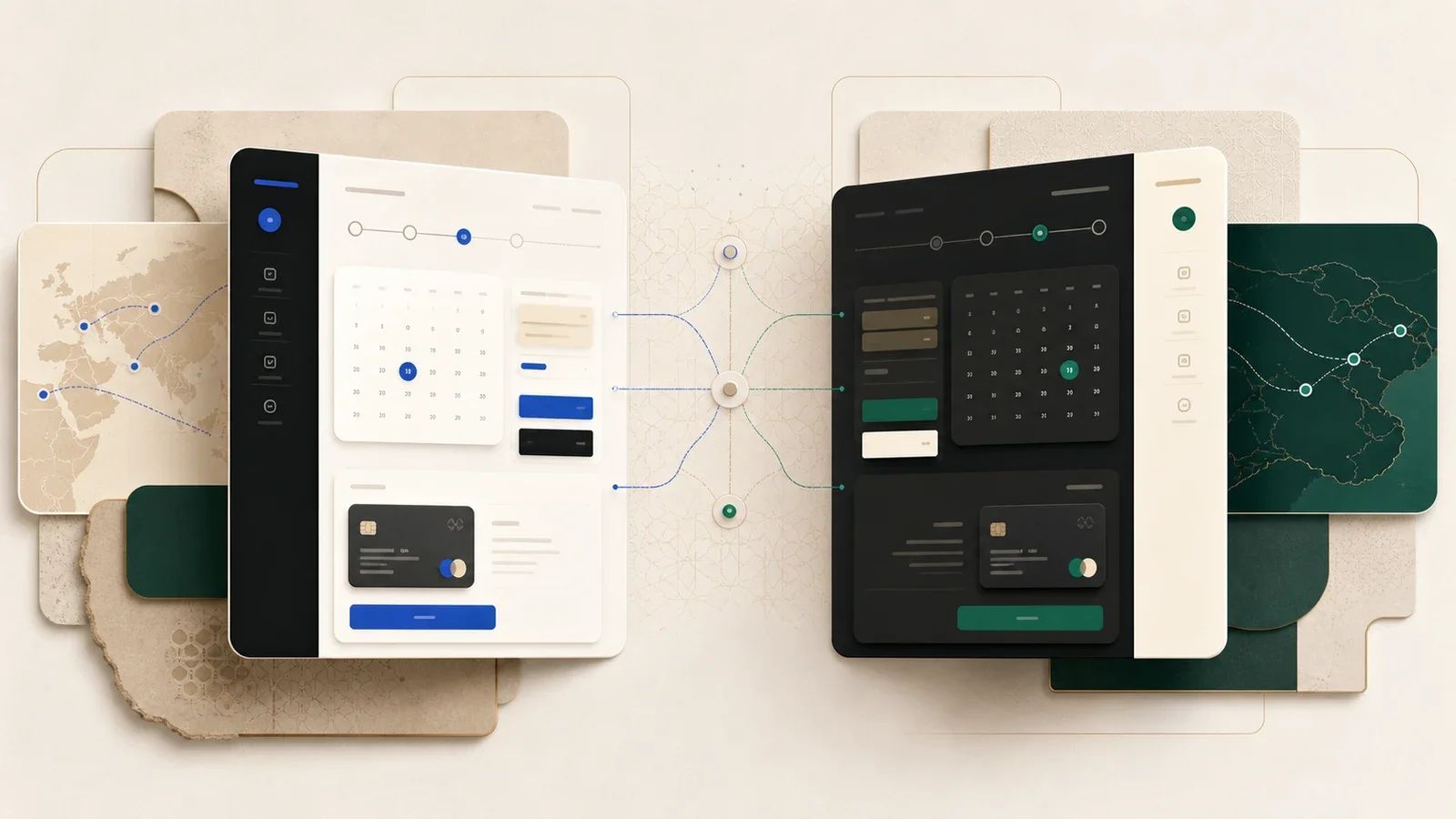
A translated interface can still feel unmistakably foreign. The words may be Arabic while navigation, forms, dates, payment assumptions, and support workflows continue to behave as if the product were built for another market. Users notice that mismatch immediately. It appears as hesitation, input errors, abandoned checkout, and a subtle lack of trust that no polished translation can repair.
That is why Arabic-first work belongs in product architecture. The objective is not to mirror every pixel or replace every string. It is to create a system whose layout, data model, operations, and content rules can express the region naturally. Done well, this work also improves the product for every locale because hidden assumptions become explicit engineering decisions.
Direction is behavior, not a CSS switch
Right-to-left direction changes scanning order, hierarchy, navigation placement, carousel movement, progress indicators, tables, and the relationship between labels and controls. Some icons should mirror; others, such as a universal media control or a brand mark, should not. Mixed strings—Arabic copy containing an email address, model number, or English product name—need isolation so punctuation and numbers remain understandable.
Build components with logical properties such as inline start and inline end instead of encoding left and right. Test layout behavior at the component level, not only on completed pages. The component library should document direction rules for icons, animation, truncation, alignment, and embedded third-party widgets. This makes RTL a normal system state rather than a late exception.
Locale belongs in the data model
Dates, calendars, decimal separators, currencies, phone numbers, personal names, and addresses are structured data—not decorative strings. Store canonical values and render them through locale-aware formatters. Never assume every person has a first and last name, every address follows the same order, or every phone number fits a domestic mask. Validation should protect the business rule without rejecting legitimate local input.
Content also needs an operating model. Define which fields are translated, how fallback behaves, who approves terminology, and what happens when Arabic content is not ready. A silent fallback to English may be acceptable in an internal dashboard but damaging in a legal notice or checkout. Those decisions should be visible in the CMS and release process.

Local journeys extend beyond the screen
A product feels local when the full task works. That includes payment methods customers actually use, identity and government integrations where required, invoice rules, delivery conventions, consent language, and access to support in the expected channel. If the final payment or verification step breaks the regional model, an elegant RTL homepage has solved the least important part.
Map the journey with local operations, compliance, customer support, and native speakers before implementation. Separate legal requirements from familiar conventions and from preferences. This prevents the team from overgeneralizing one market across the entire Arabic-speaking world, where dialect, regulation, payments, and user expectations can differ significantly.
Test for comprehension and confidence
Screenshot comparisons will reveal overflow and alignment problems, but they cannot confirm that a journey makes sense. Run tasks with native users on representative devices. Watch for pauses around labels, uncertainty in form fields, repeated backtracking, and switching to another language. Ask what users expected to happen, not simply whether they liked the design.
A useful launch gate covers bidirectional layout, keyboard and screen-reader order, mixed-direction text, locale formatting, long and short translations, empty states, transactional messages, payments, support handoff, and analytics segmentation by locale. Arabic-first architecture is ultimately about respect: the product should meet people in their language without asking them to adapt to somebody else’s assumptions.
About Muhammad Khalid Umar
Founder and CEO of NutshellBytes, sharing practical lessons from building software products, AI systems, and digital businesses.